Meet our Members: Elin Lund Rolstad
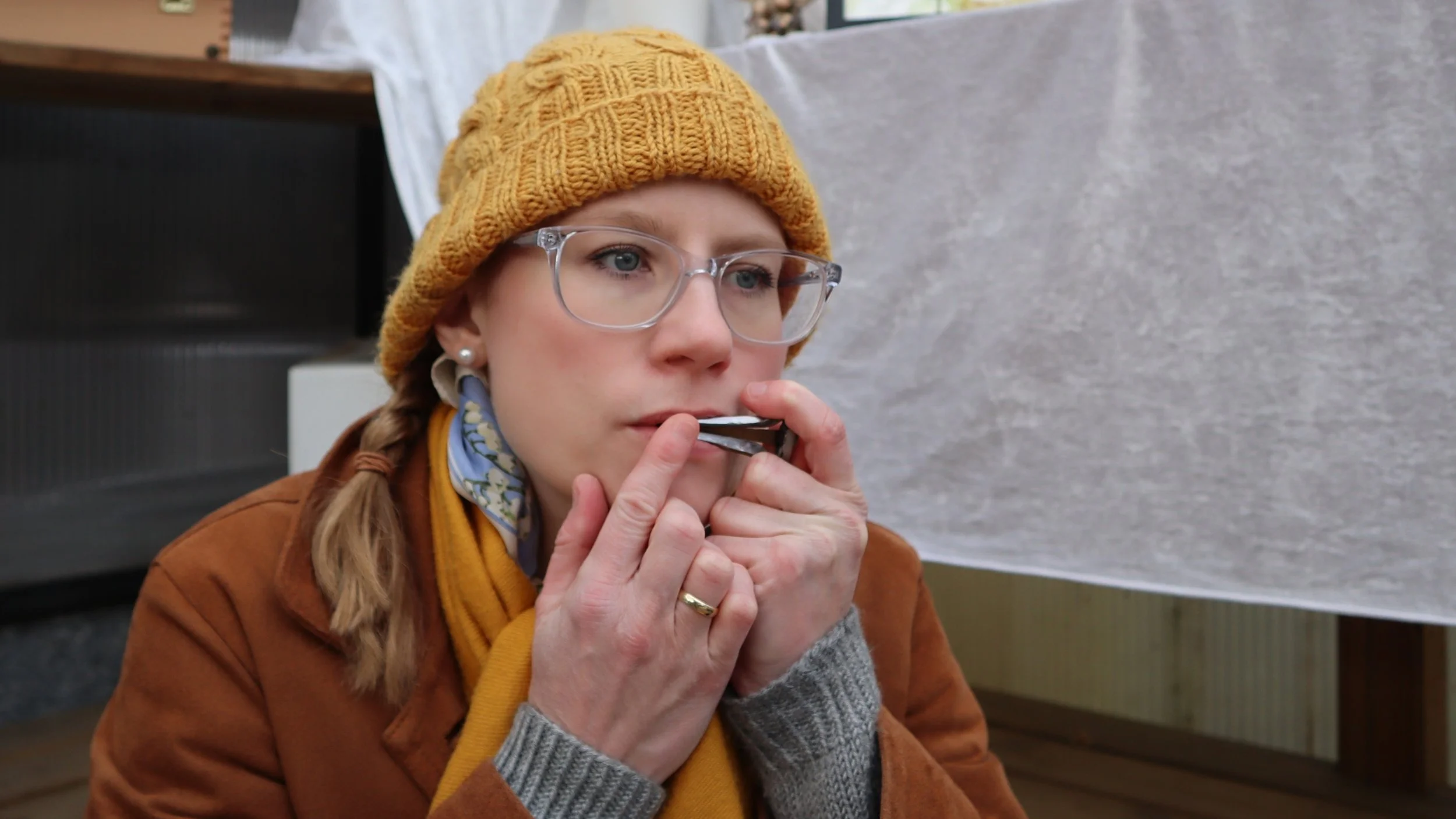
Elin Lund Rolstad began playing the Jew’s harp in 2025.
Elin Lund Rolstad (39) from Sarpsborg is a special needs teacher and a brand-new member of the Norwegian Jew’s Harp Forum (NMF).
By Bernhard Folkestad
Translated by Lucy Moffatt
When did you first hear the Jew’s harp?
I grew up in a family where there was music going on pretty much all the time. My father had a cheap, simple Jew’s harp that he always carried around in his cornet case, a tiny secondary instrument just for fun. In spring 2025, I came across a few YouTube clips of Even Ellegaard Westeng from Telemark playing Jew’s harp on Norway’s Got talent. His performances were totally brilliant, and I thought he achieved something that was truly unique. That made me want to learn Jew’s harp myself.
How did you start playing?
I got curious about the techniques, especially overtone playing and the way even small changes in breathing and mouth shape create new tones. I started looking online for videos as a way of learning more and gaining inspiration. I found an Oslo-based workshop in June led by Kyrre Matias Goksøyr and signed up for it. He’s an incredibly patient and knowledgeable instructor. I had to listen a lot to start off with and it took a while for me to crack at least part of the code. In July, I had a few lessons with Bernhard Folkestad in Horten. Bernhard’s stories and anecdotes didn’t just make the classes instructive and genuinely inspiring, they also gave me a deeper understanding and motivation that was really valuable. Some great course material has been produced, including sound files and a booklet. In October 2025, I took an intermediate Jew’s harp course during the Klangen før fela festival at Oslo’s Riksscenen with the super talented Jew’s harp instructor Jim Erik Hoem Johansen. I learned so much.

Elin visits Bernhard Folkestad in Horten.
What do you play?
I mostly play Norwegian folk material like Setesdal tunes, a few hymns, songs and children’s songs. At the workshop with Jim Erik Hoem Johansen I learned to play ‘Bråtasæterhallingen fra Sør-Fron’ and ‘Bukkehornsmarsj fra Tresfjord’, among others. I’ve also been seeking out religious folk tunes, of which there are quite a few. It’s important to listen to plenty of Jew’s harp music because that trains your ability to listen properly. I listen a lot to Thov Wetterhus, who’s an outstanding Jew’s harp player. His version of ‘Fanitullen’ is really great. Other than that, I listen a lot to Bjørgulv Straume, Hallgrim Berg, Erik Røine, Anders Erik Røine, Svein Westad, Sigurd Brokke, Daniel Sandén-Warg and Ånon Egeland, to name just a few. If you want to learn as much as possible, you have to listen to Fille-Vern – Gamle og nye mestre i norsk munnharpetradisjon (Fille Vern – Old and new masters of the Norwegian Jew’s harp tradition).
When do you play?
I listen a lot to tunes, recordings and workshops while I’m doing housework (I have them on in the background); and I play for the kids now and then, when they feel like listening, as well as while I’m cooking, sometimes when I’m out hiking in the forest, out in nature, and a bit in the evenings when I feel like a creative break. I usually have a Jew’s harp or two on me when I’m exhibiting my paintings around and about. I paint watercolours and acrylics as a hobby. If it feels right, I’ll often take out my Jew’s harp and play a little. I can see that quite a few people get enthusiastic and think it’s fun to listen to. I’ve also played for pupils at the school.
What do you think about when you play?
I actually think about the fact that my body, my oral cavity and my head are supposed to act as a resonance chamber, and I try to open up a bit when I play. I think I need to know the melody well enough to be able to play it without thinking – that’s when it works best. If I’ve been playing a tune for a long time, I may catch myself thinking about people, animals, plants, colours or shapes – there’s often a free flow of associations.
What do you think makes a good Jew’s harp tune?
A good Jew’s harp tune has plenty of drive. I like tunes that are complex and develop along the way. They have to have a clear drive, but there also has to be room for tone. I also think there should be some space for improvisation, but ask me again in a year; I need a bit of time to mature as a player. I feel like I’ve barely started and have an awful lot to learn.
What’s the best thing about the Jew’s harp?
It has to be meeting other people in the Jew’s harp world, and the joy of discovering new tunes. Playing Jew’s harp can give you an almost euphoric feeling that makes you forget time and place, and – at its best – there’s a kind of eternity in the repetitions. I feel truly alive when I play. The fact that I’ve just barely started to learn makes me feel like we can always learn and experience more.
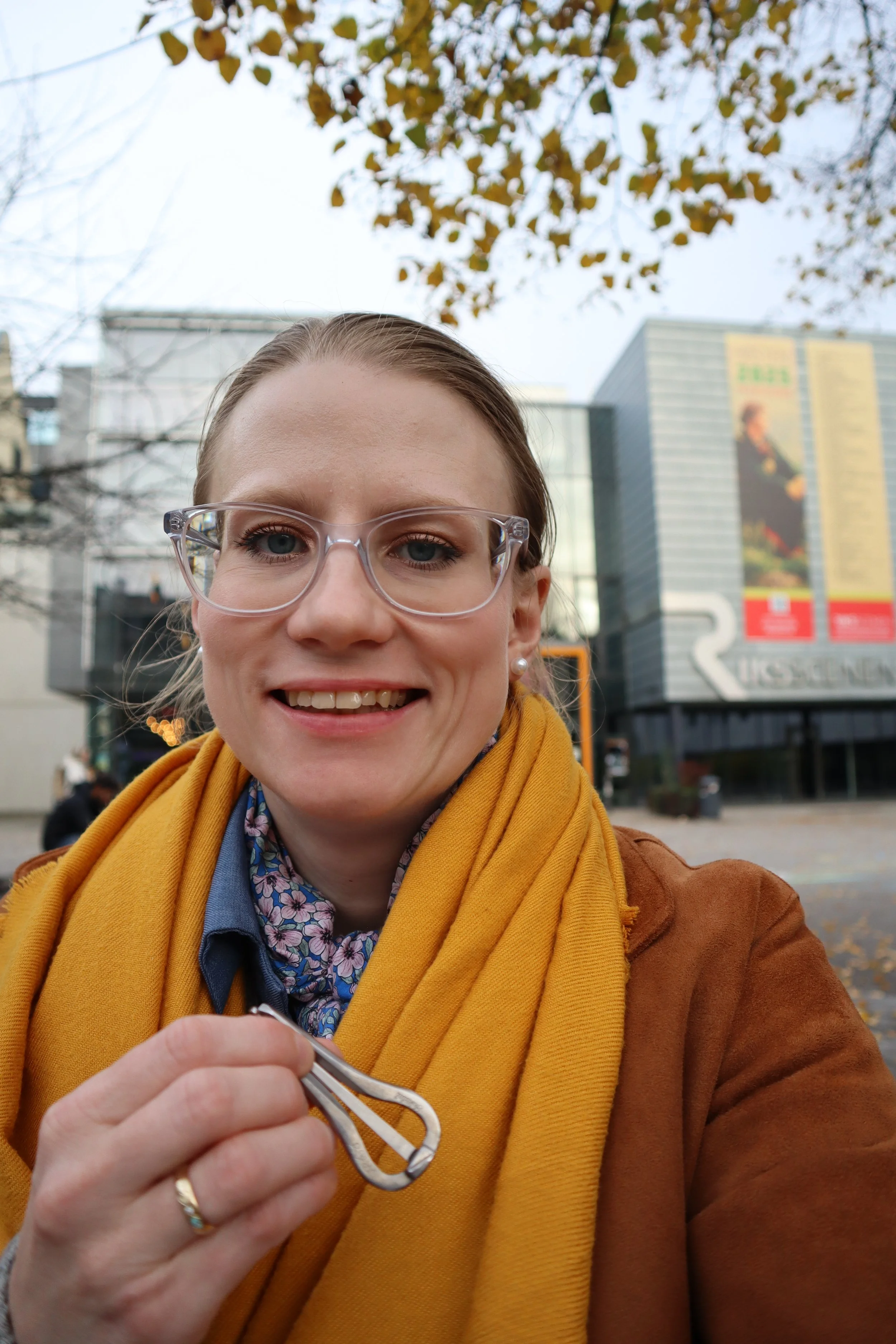
Elin in front of the Riksscenen in Oslo where she participated in a Jew’s harp course during the Klangen før fela festival.